Image 1 of 20
Image 2 of 20
Image 3 of 20
Image 4 of 20
Image 5 of 20
Image 6 of 20
Image 7 of 20
Image 8 of 20
Image 9 of 20
Image 10 of 20
Image 11 of 20
Image 12 of 20
Image 13 of 20
Image 14 of 20
Image 15 of 20
Image 16 of 20
Image 17 of 20
Image 18 of 20
Image 19 of 20
Image 20 of 20
Set of 4 1960s Danish Modern Teak Dining Chairs in Zebra Print Upholstery
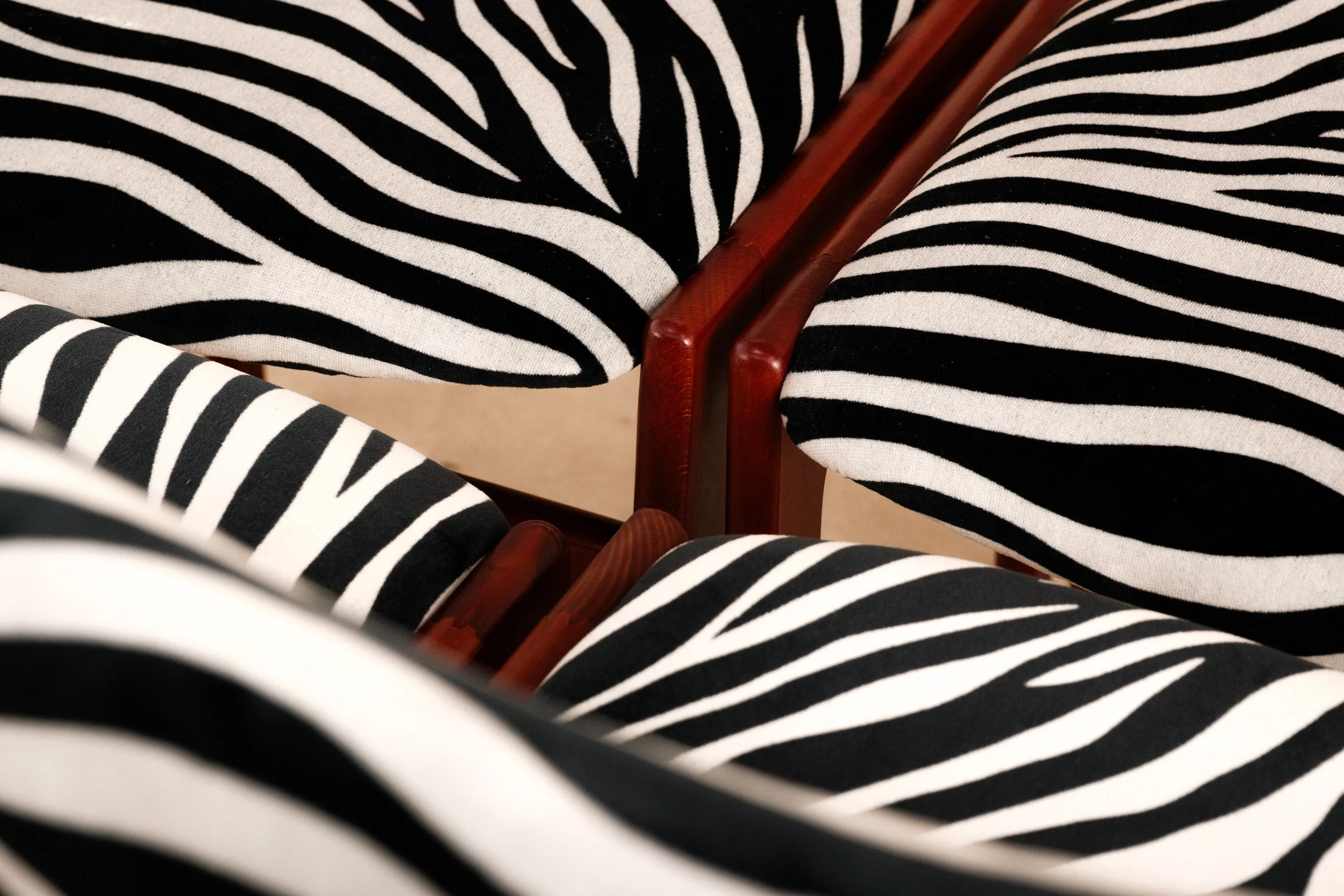
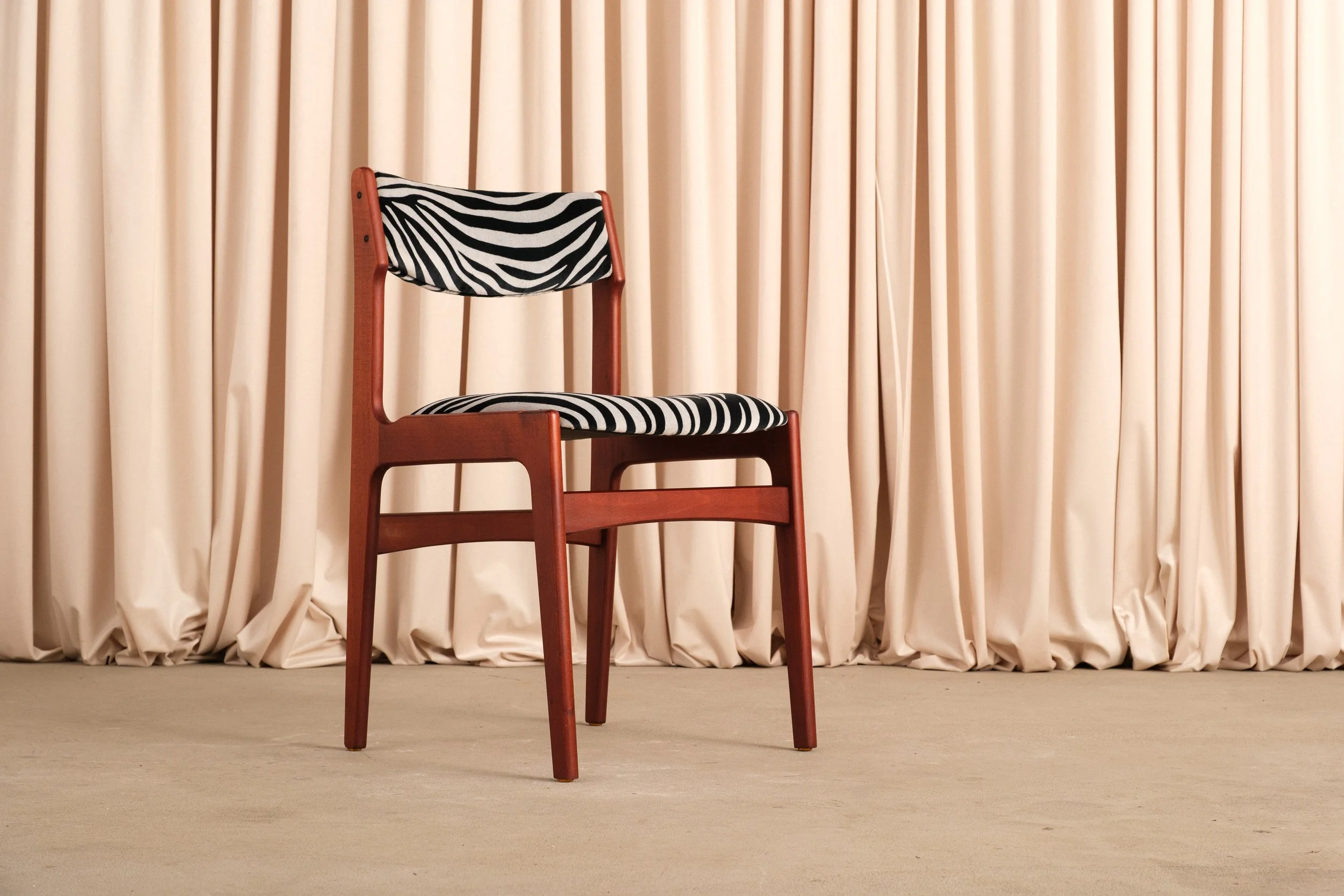
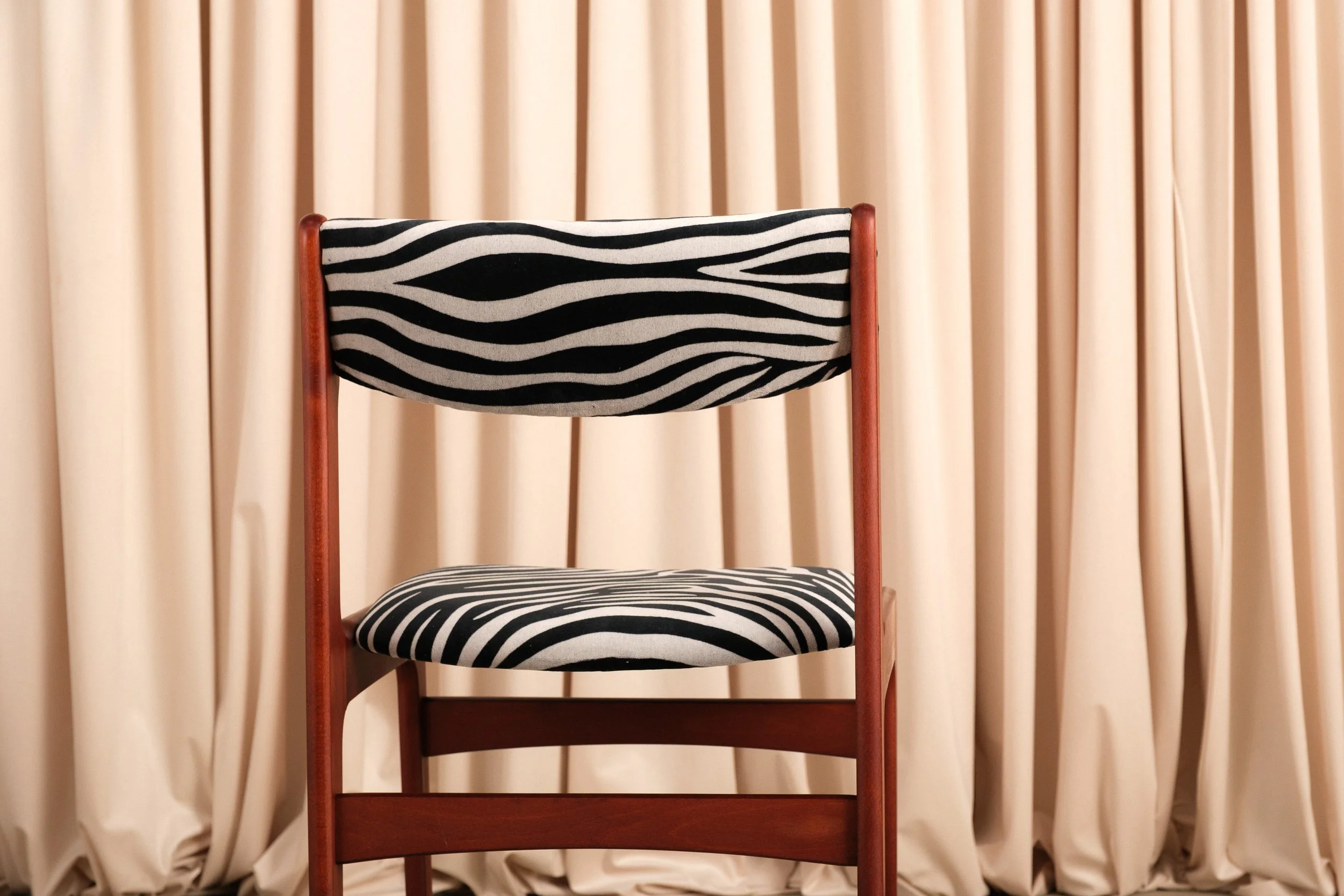
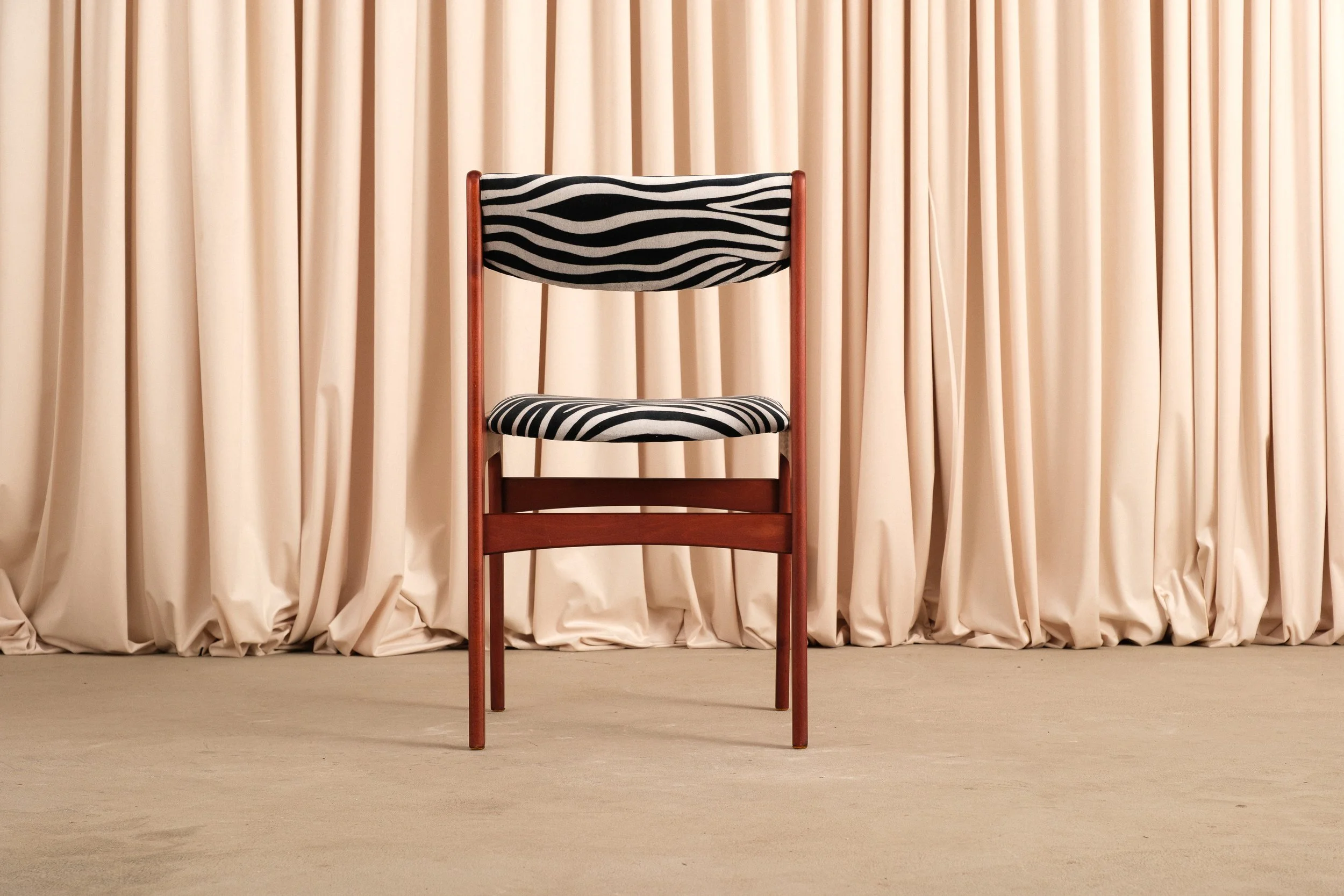
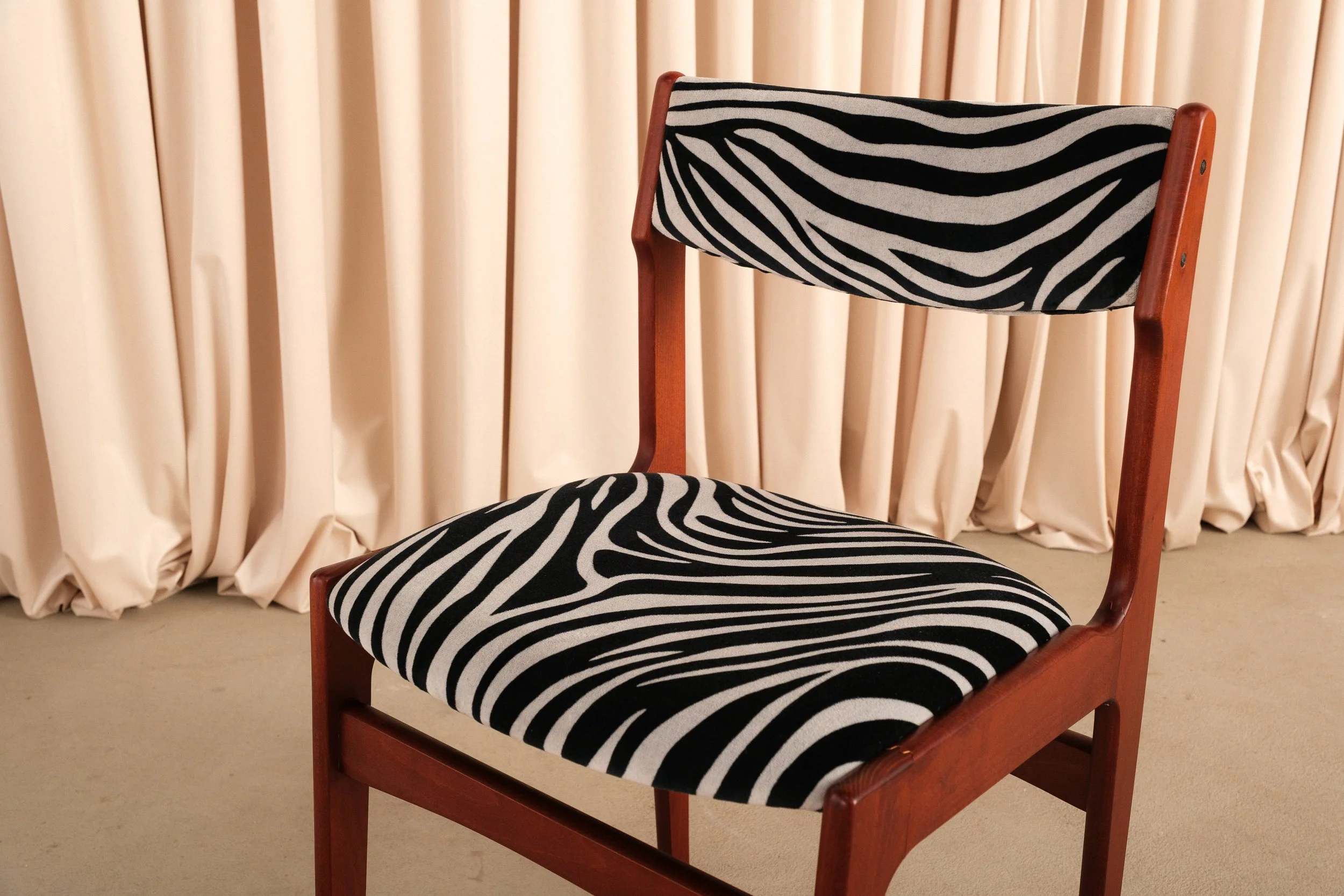
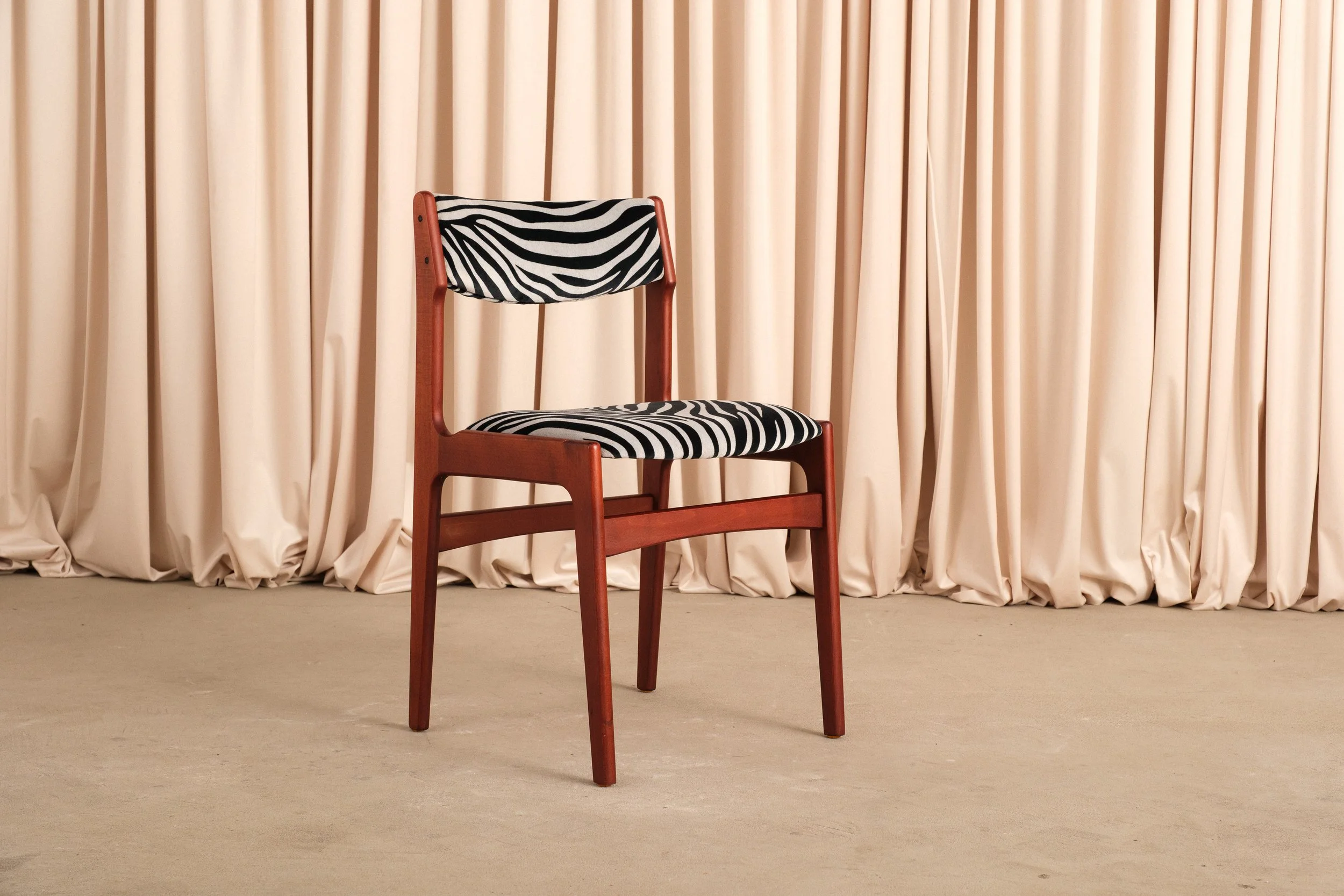
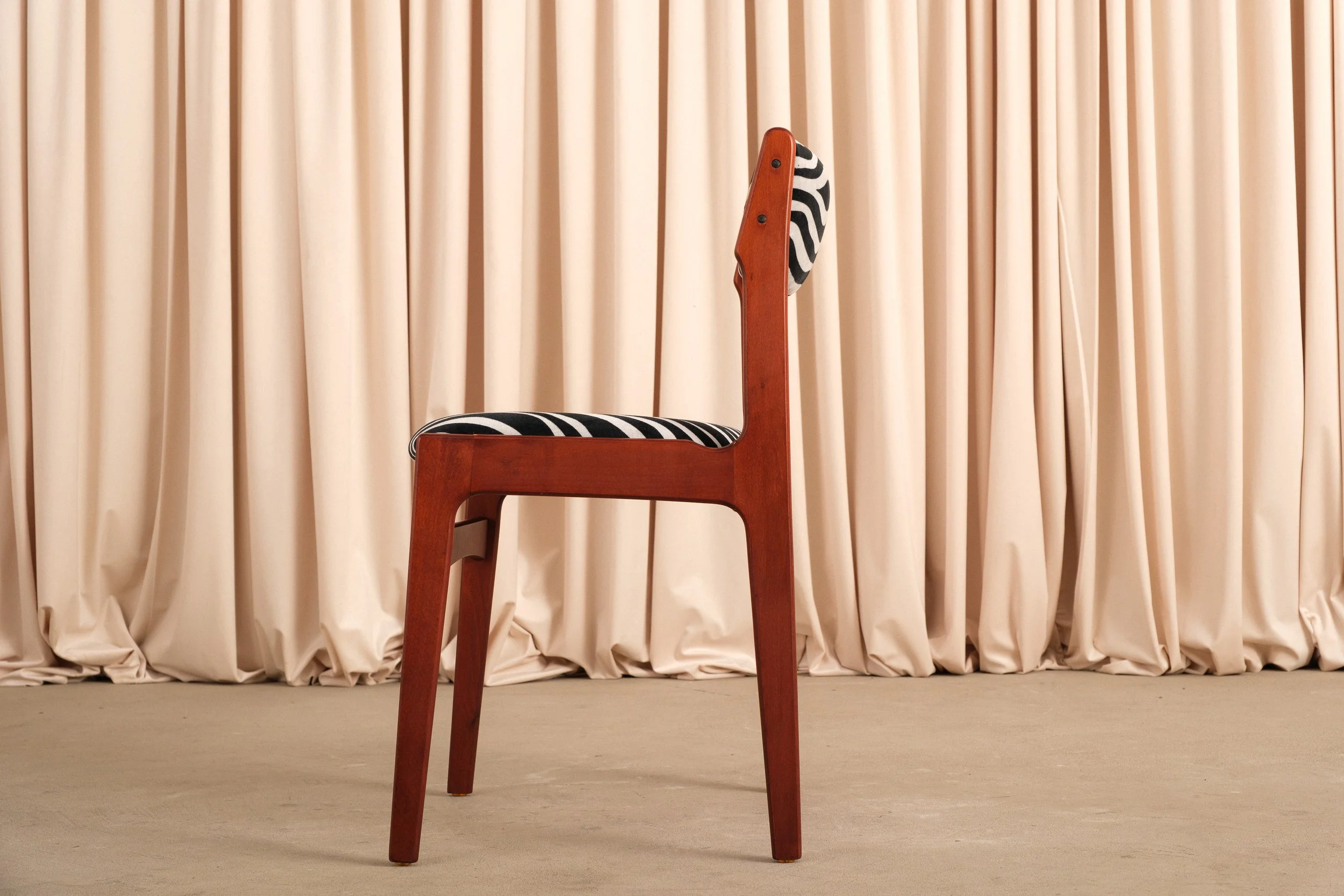
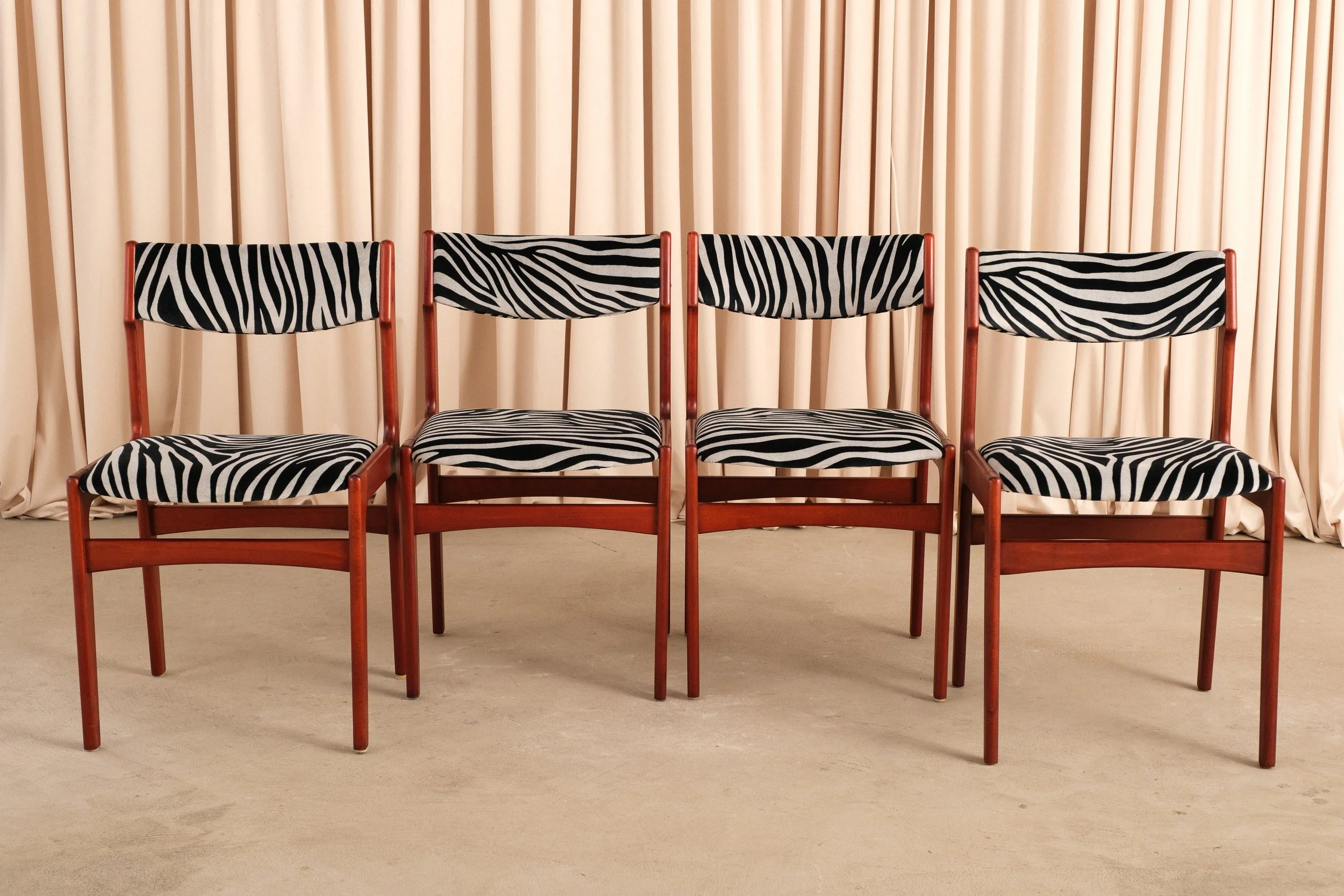
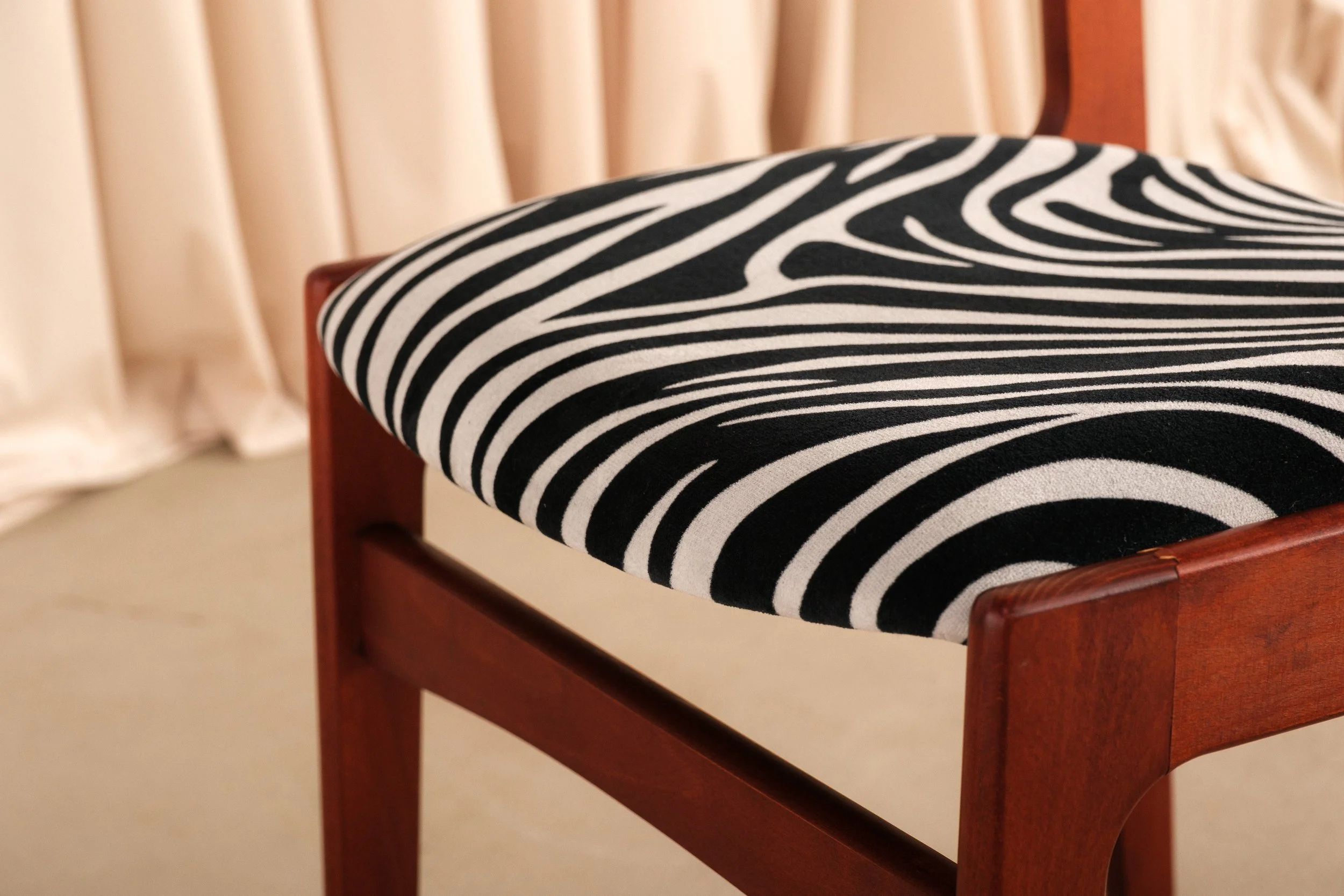
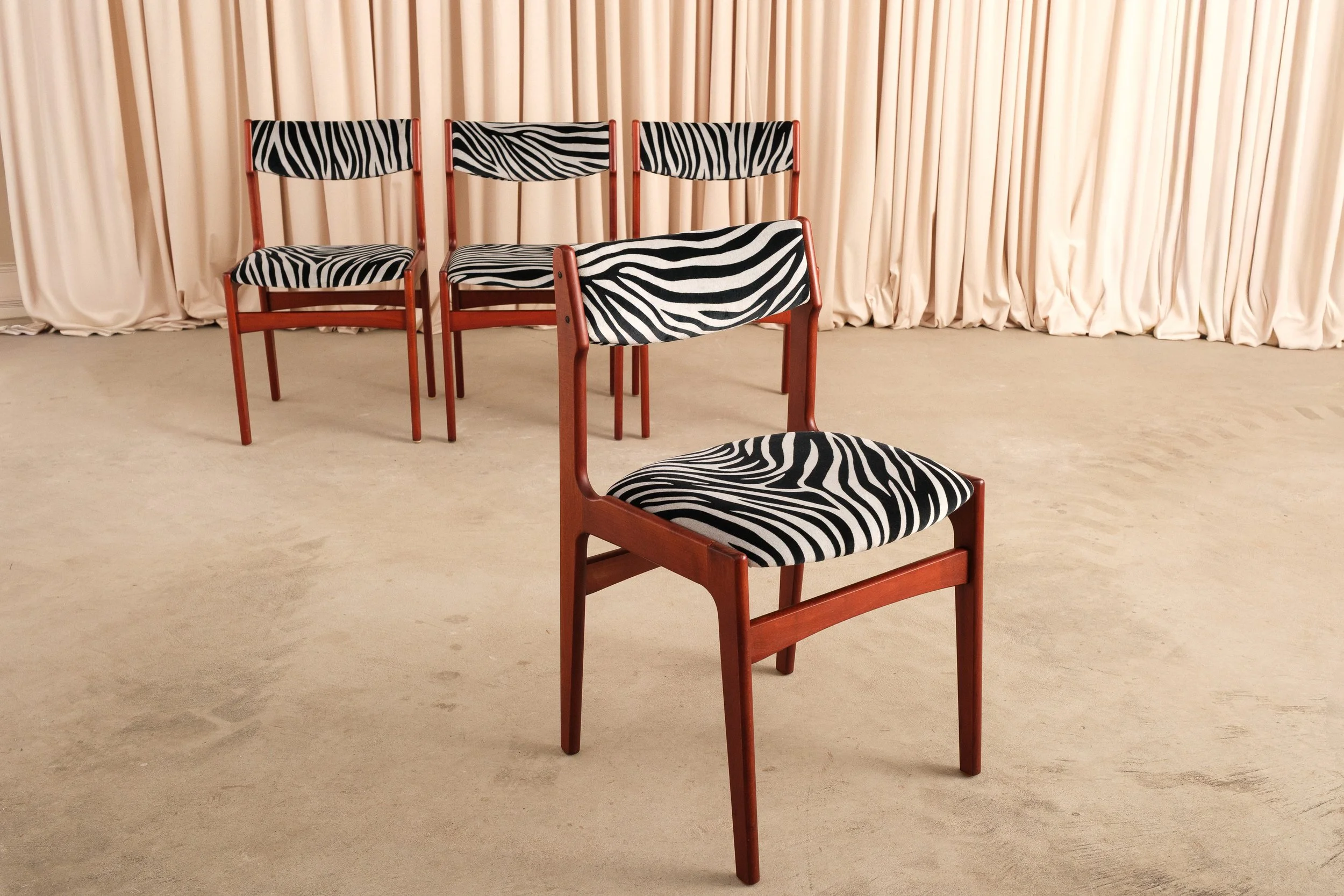
A set of four Danish modern teak dining chairs from the 1960s, newly reupholstered in a bold black and white zebra print fabric.
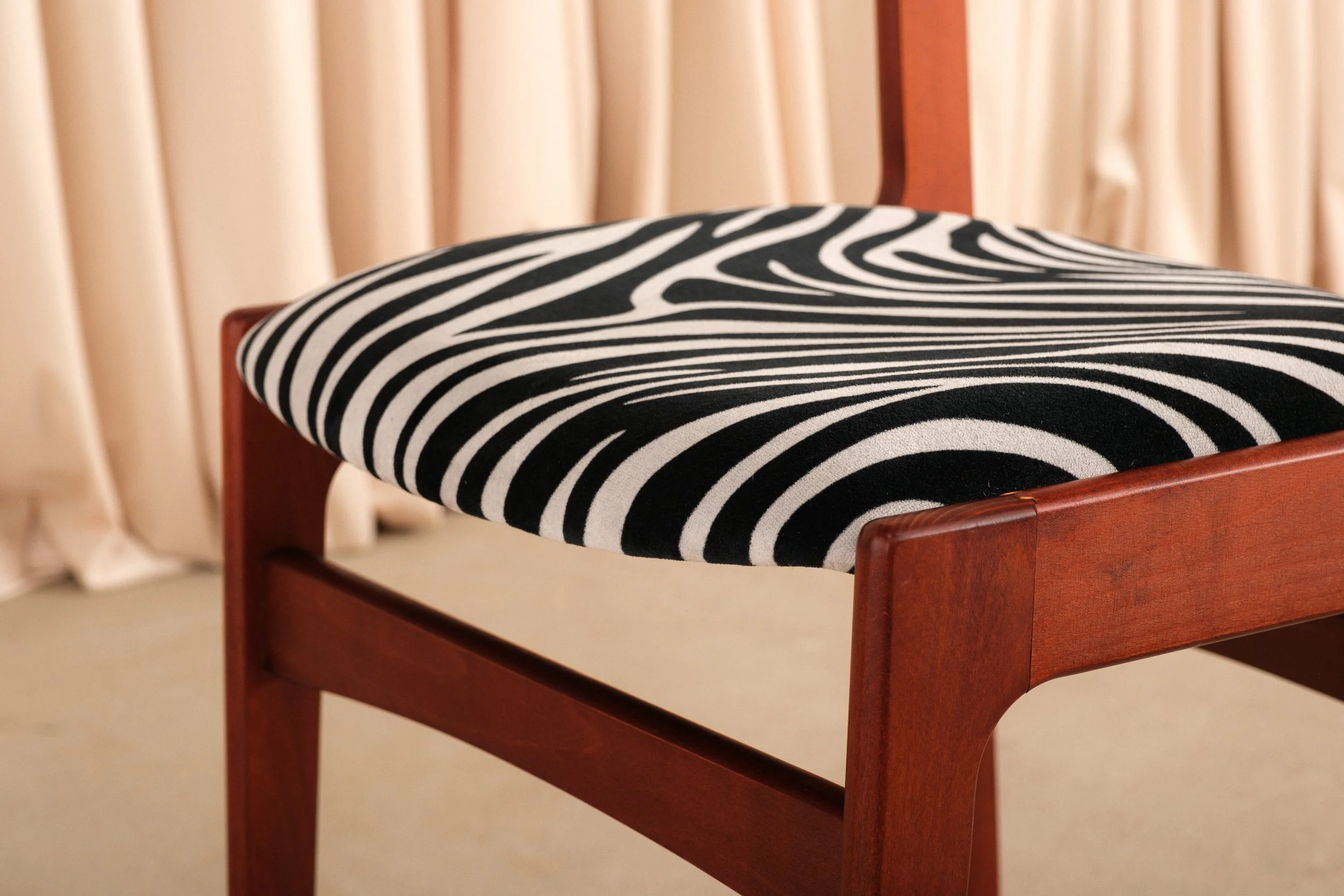
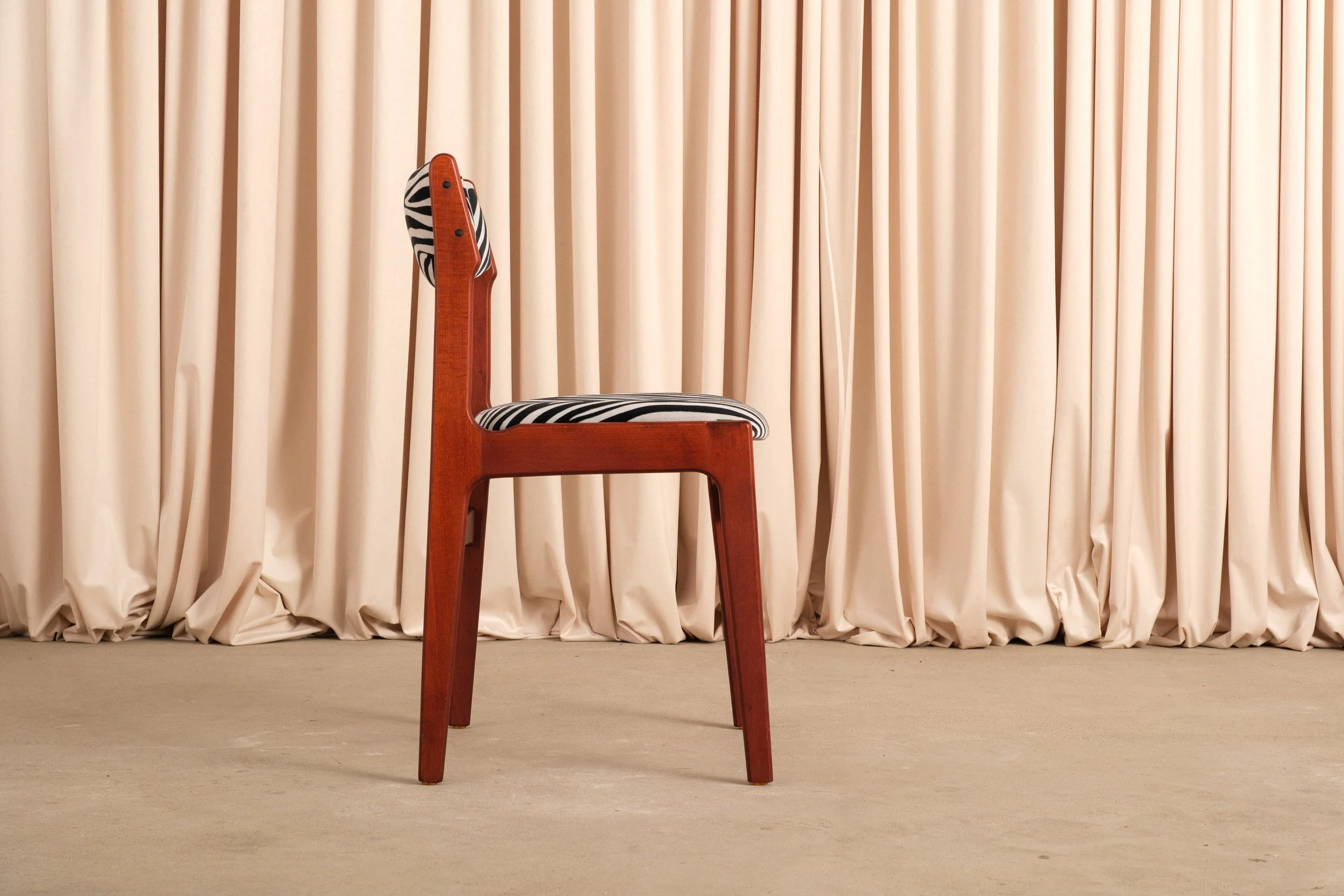
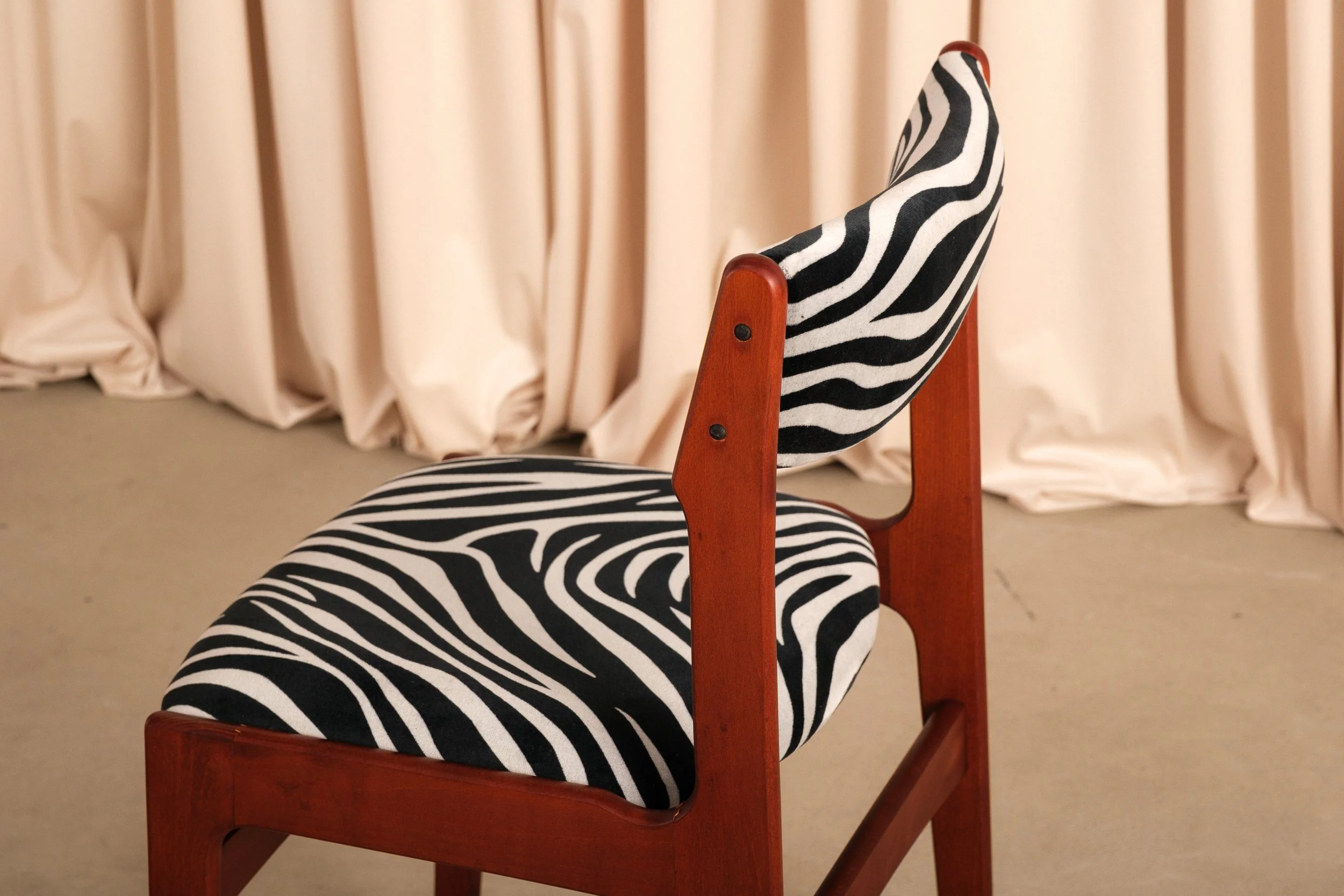
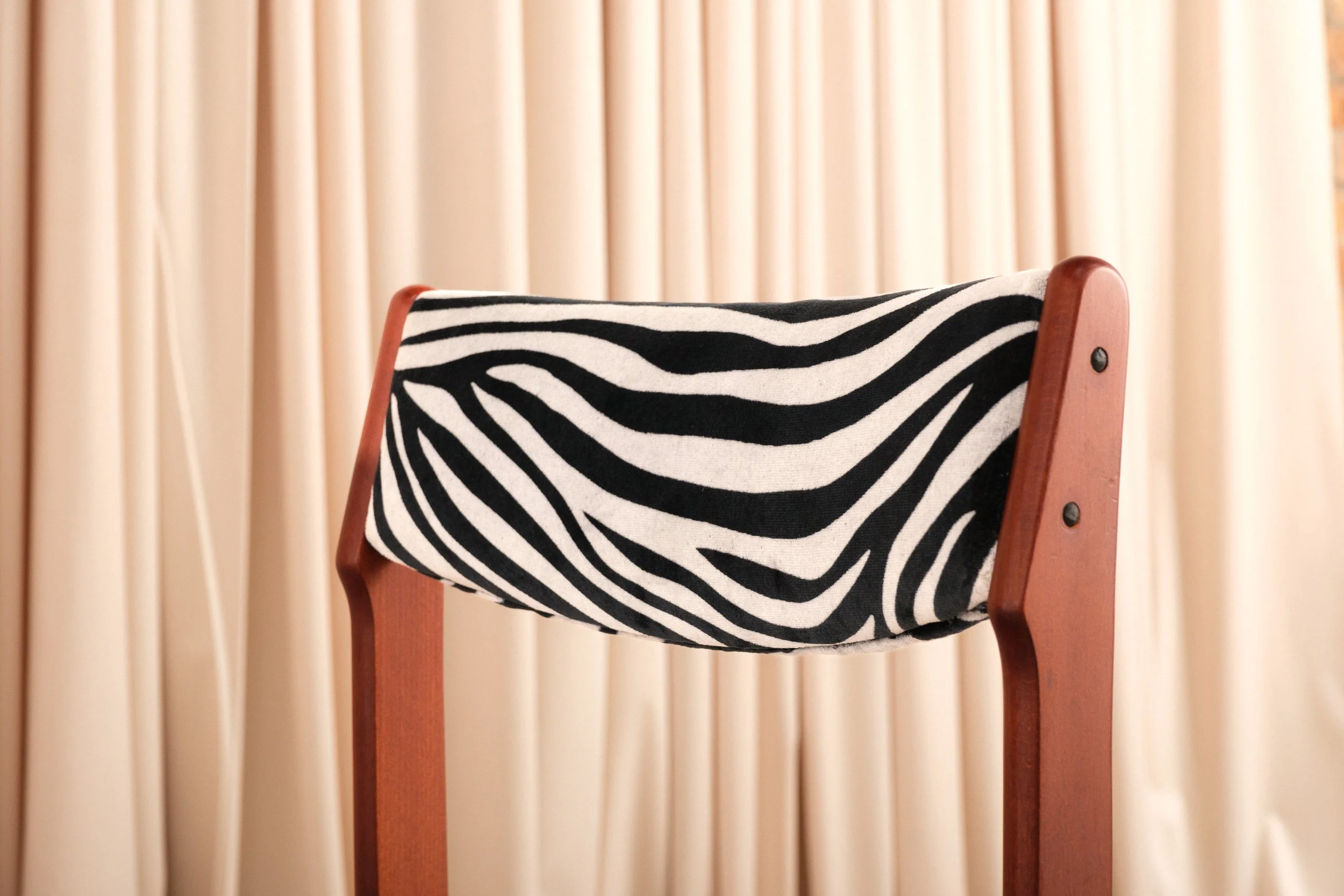
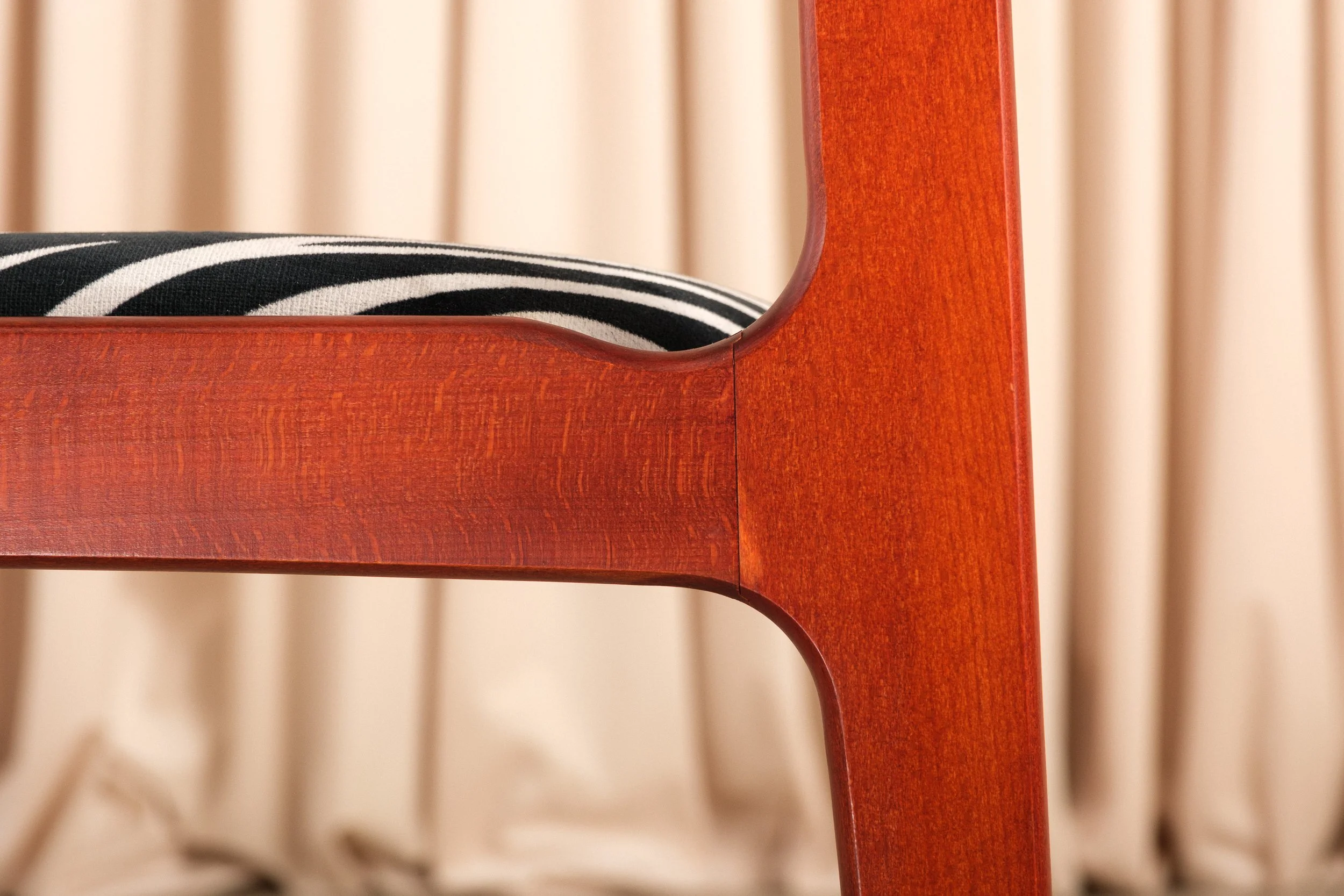
The chairs are unmarked, we haven't been able to identify the specific manufacturer, which wasn't unusual for smaller Danish workshops producing furniture in this period. The construction is consistent with quality Danish cabinetmaking of the 1960s: solid teak frames with the characteristic reddish-brown tone that comes from the species itself rather than staining, clean-lined joinery, and a straightforward silhouette that was common across several Danish makers of the era. The back panel is a separate upholstered piece that attaches to the frame, floating slightly above the seat, a detail that gives the chair a lighter, more open look from behind.
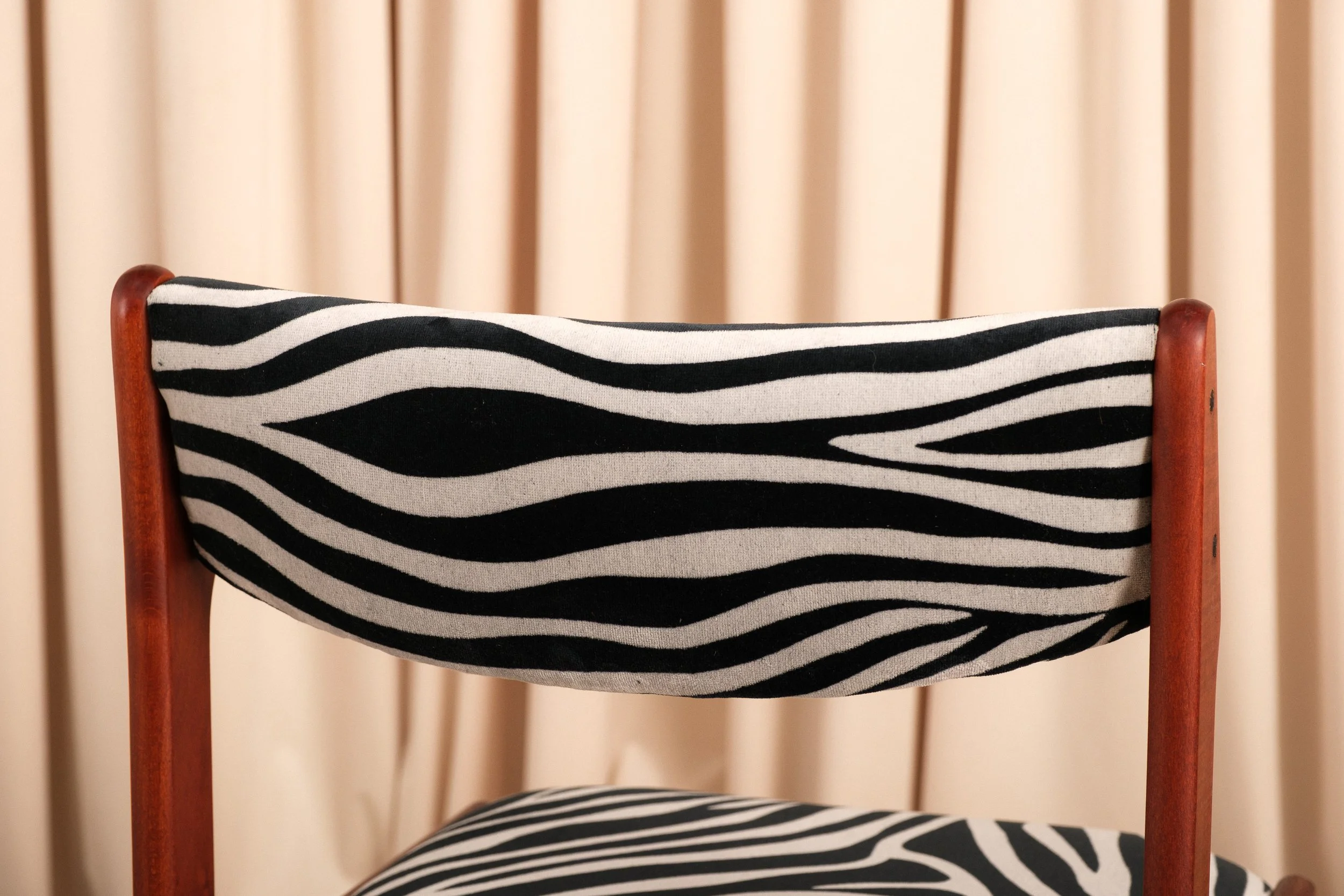
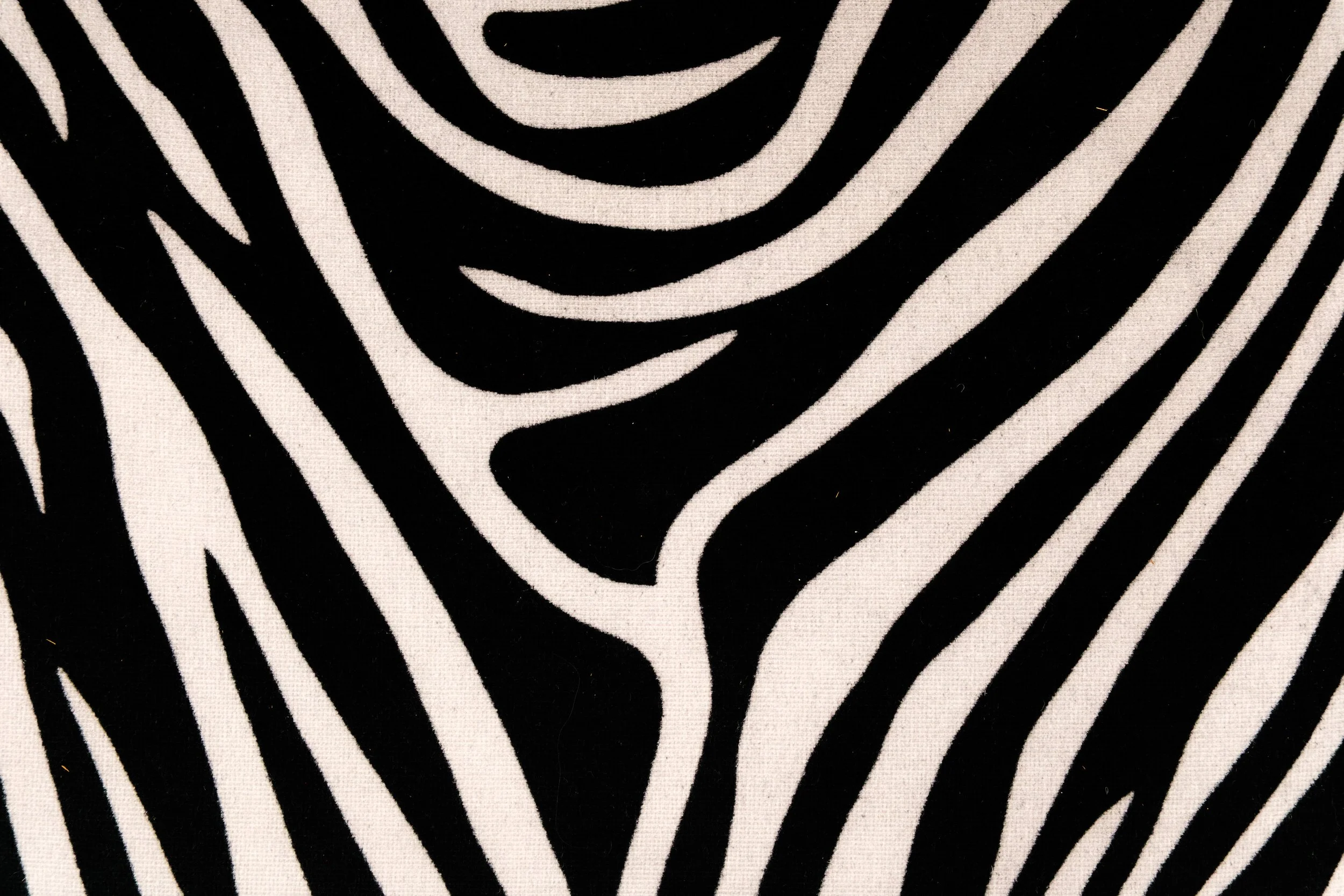
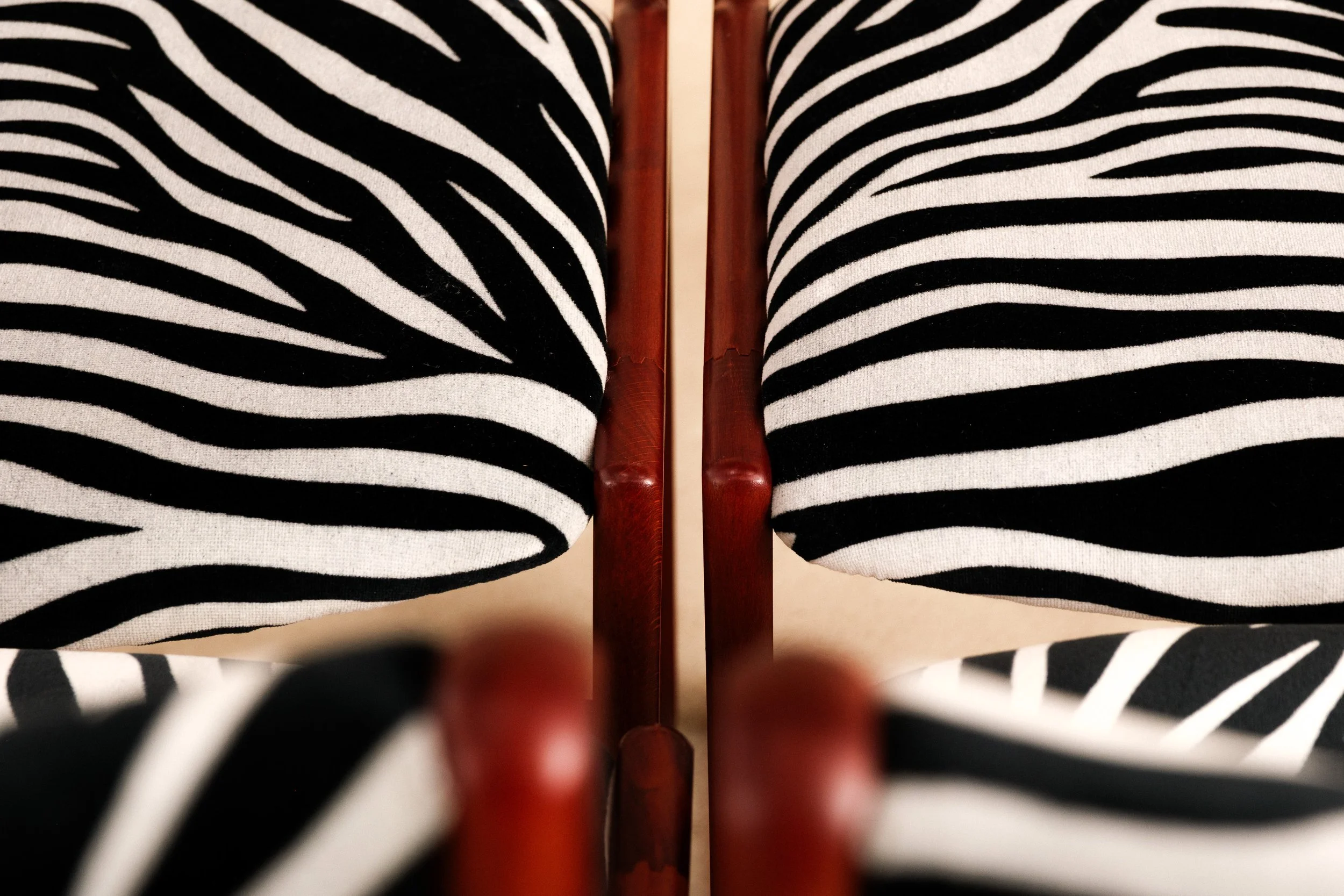
The zebra print fabric is new. It's a deliberate choice that sits somewhere between Danish restraint and something a bit more playful, the graphic black and white pattern reads strongly against the warm teak, and the contrast works better in person than you might expect from photos. If you're looking for chairs that blend into a room, these aren't them. If you want four chairs that become part of the conversation, they'll do that.
A set of four is useful: enough for a small dining table, or split into pairs in different rooms.
A set of four Danish modern teak dining chairs from the 1960s, newly reupholstered in a bold black and white zebra print fabric.
The chairs are unmarked, we haven't been able to identify the specific manufacturer, which wasn't unusual for smaller Danish workshops producing furniture in this period. The construction is consistent with quality Danish cabinetmaking of the 1960s: solid teak frames with the characteristic reddish-brown tone that comes from the species itself rather than staining, clean-lined joinery, and a straightforward silhouette that was common across several Danish makers of the era. The back panel is a separate upholstered piece that attaches to the frame, floating slightly above the seat, a detail that gives the chair a lighter, more open look from behind.
The zebra print fabric is new. It's a deliberate choice that sits somewhere between Danish restraint and something a bit more playful, the graphic black and white pattern reads strongly against the warm teak, and the contrast works better in person than you might expect from photos. If you're looking for chairs that blend into a room, these aren't them. If you want four chairs that become part of the conversation, they'll do that.
A set of four is useful: enough for a small dining table, or split into pairs in different rooms.
-
Dimensions: 19.5"W × 18.5"D × 31"H | Seat Height: 17.5"
Origin: Denmark
Period: 1960s
Materials: Solid teak frame, newly reupholstered in zebra print fabric.
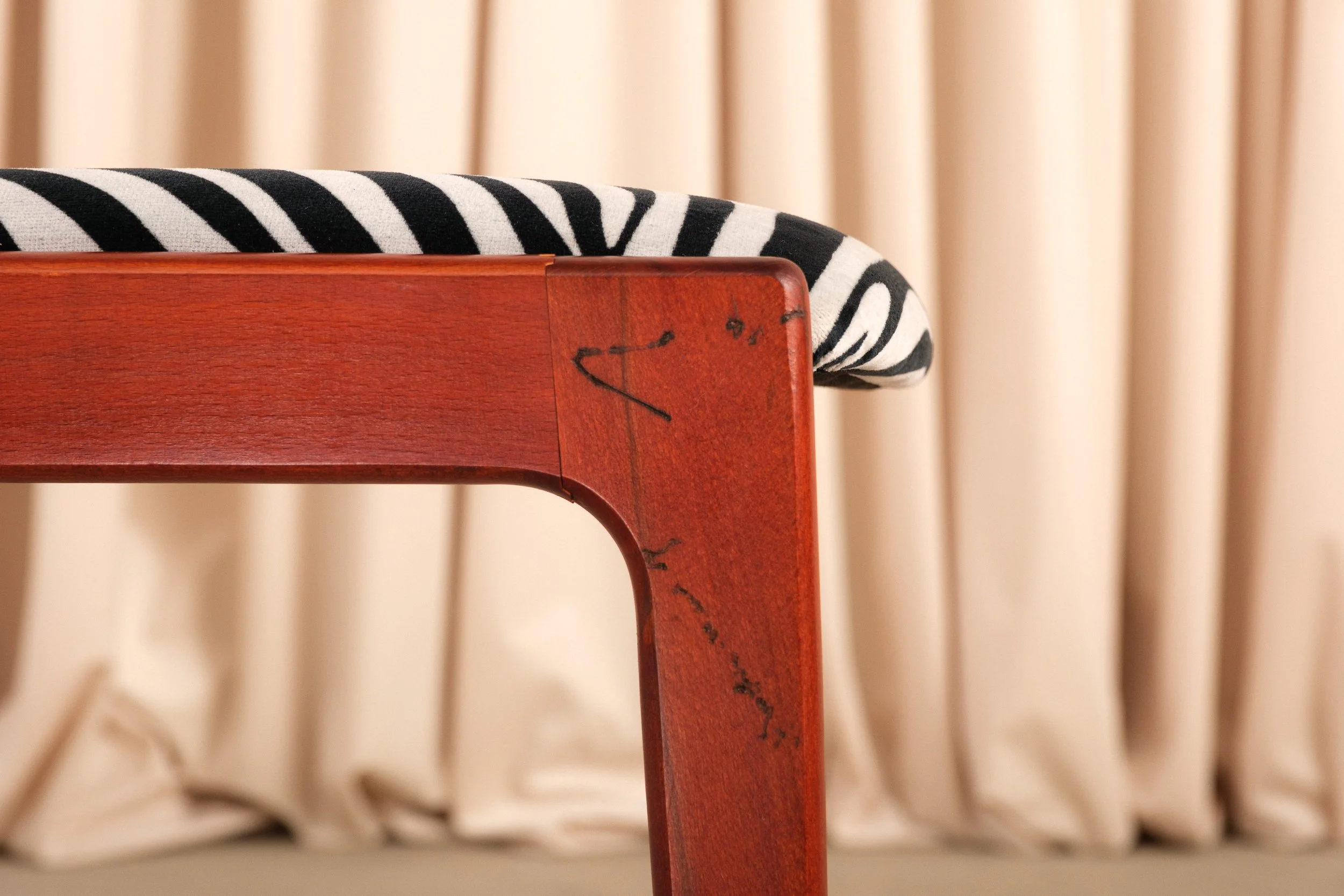
Condition: Good vintage condition. Frames show minor wear consistent with age and shown in picture. Upholstery is new. Structurally sound throughout
-
Local Pickup: Local pickup is available by appointment from our warehouse and is free of charge. Pickup must occur within 7 calendar days of purchase unless otherwise agreed to in writing.
Local Delivery: Local delivery is available within the city of Chicago through trusted third-party carriers for aflat rate of $150. Expedited delivery may be available at additional cost.
White Glove Delivery: White Glove delivery is available through trusted third-party carriers and includes in-home placement and removal of packaging debris. Availability and pricing vary by item and location—please contact in advance for a quote.
Shipping: Domestic shipping in the U.S. is available via USPS for eligible smaller items. In-stock pieces typically ship within 5–7 business days.
View all shipping policies here.
-
This piece is being sold as a vintage item. Minor variations, patina, and signs of wear are part of its character and authenticity.
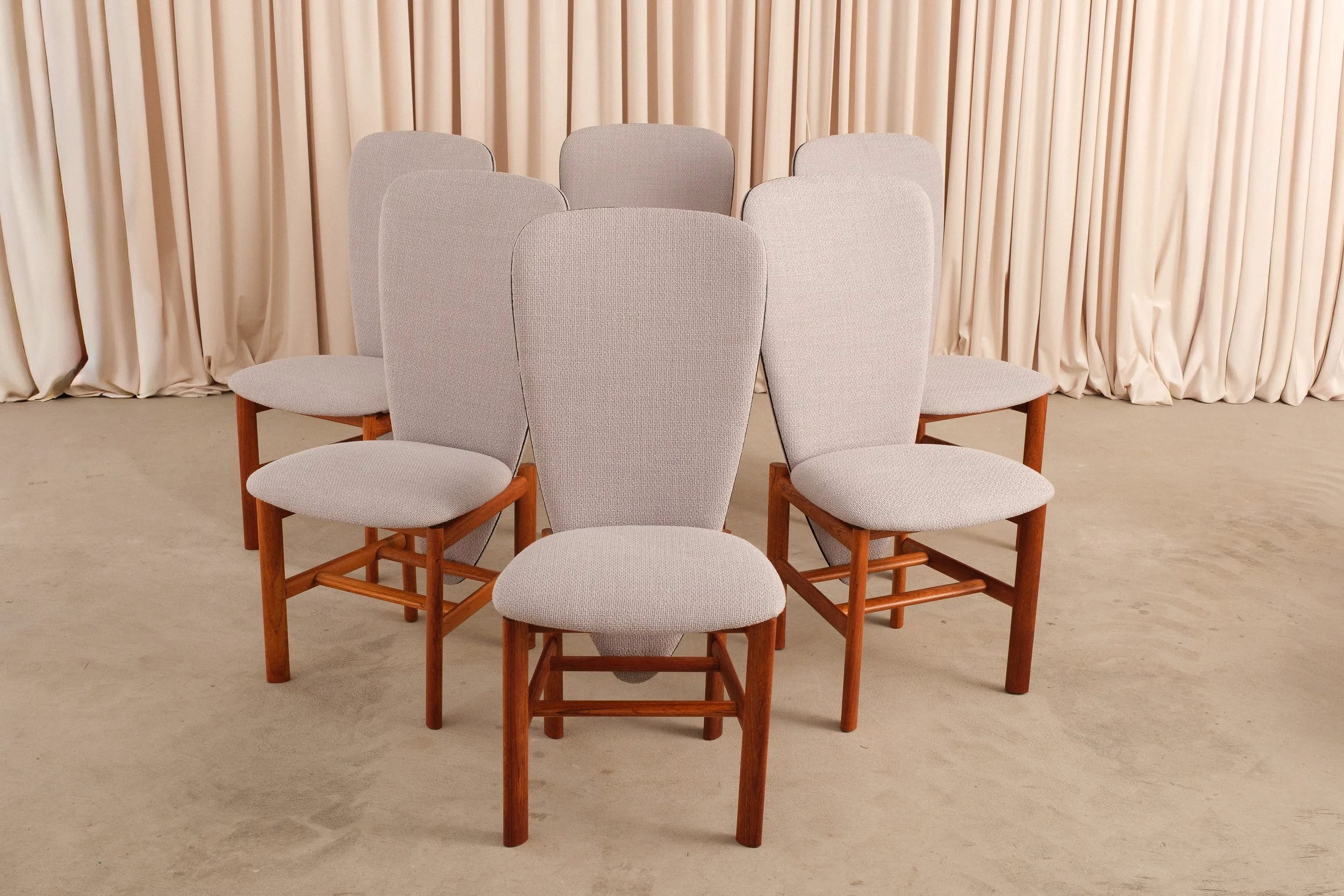
Skovby Møbelfabrik was founded in 1933 by Thorvald Rasmussen, a skilled cabinetmaker who built the company on a simple conviction: that furniture should be made to last, and that lasting furniture should also be beautiful. By the 1960s, Skovby had become one of Denmark's most respected furniture manufacturers, producing the kind of high-back teak dining chairs that now define the golden age of Danish mid-century design.
These six chairs have the characteristic elongated triangular backs with softly rounded corners and the tubular square teak frames that make the Skovby high-back immediately recognizable. The form is architectural without being severe, the tall back creates presence at a dining table, the proportions are generous without being heavy, and the teak frame has been left with its original patina intentionally. Not restored to a uniform new appearance, but refinished, stabilized, and allowed to show the honest warmth of sixty years well-lived.
The seats have been professionally reupholstered in grey fabric.
Price is for the set of 6.
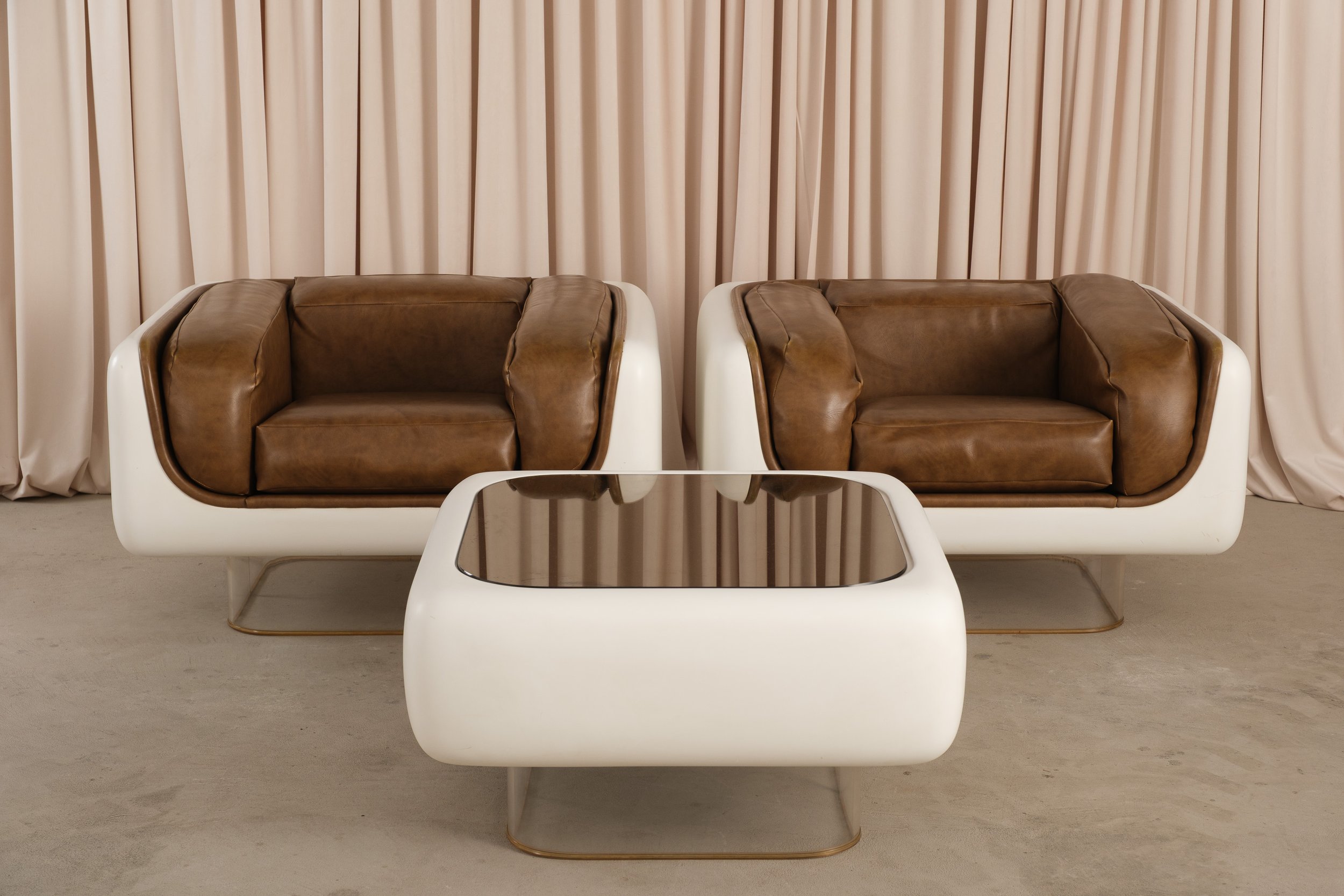
A set of two William Andrus lounge chairs and matching coffee table from the Steelcase Soft Seating Group, 1972, one of the most significant American institutional furniture designs of the Space Age period.
William Clifford Andrus designed the Soft Seating Group for Steelcase in 1972, and it won the top design award for institutional furniture and innovative use of materials that same year. The concept was precise: Andrus wanted the contrast between hard and soft, the rigid white lacquered fiberglass shells appear to float on a transparent Lucite base, while the upholstered cushions provide the softness. The result is furniture that reads as sculpture first and seating second.
These two lounge chairs retain their original khaki vinyl upholstery, the period-correct material that the group was originally specified with for institutional settings. The white fiberglass shells show minor scuffs and chips consistent with five decades of existence, honest vintage condition that we've noted accurately. The Lucite bases are intact and the structural integrity is excellent throughout.
The matching coffee table follows the same design language: white lacquered fiberglass base with a mirrored glass top. The mirror shows the kind of age marks and clouding that comes from decades of use, visible in the photos and noted honestly.
Price is for the 2 lounge chairs + coffee table set. We have also a set composed of 1 sofa + another coffee table. Inquire if you want to purchase the full set as it comes with a discount.
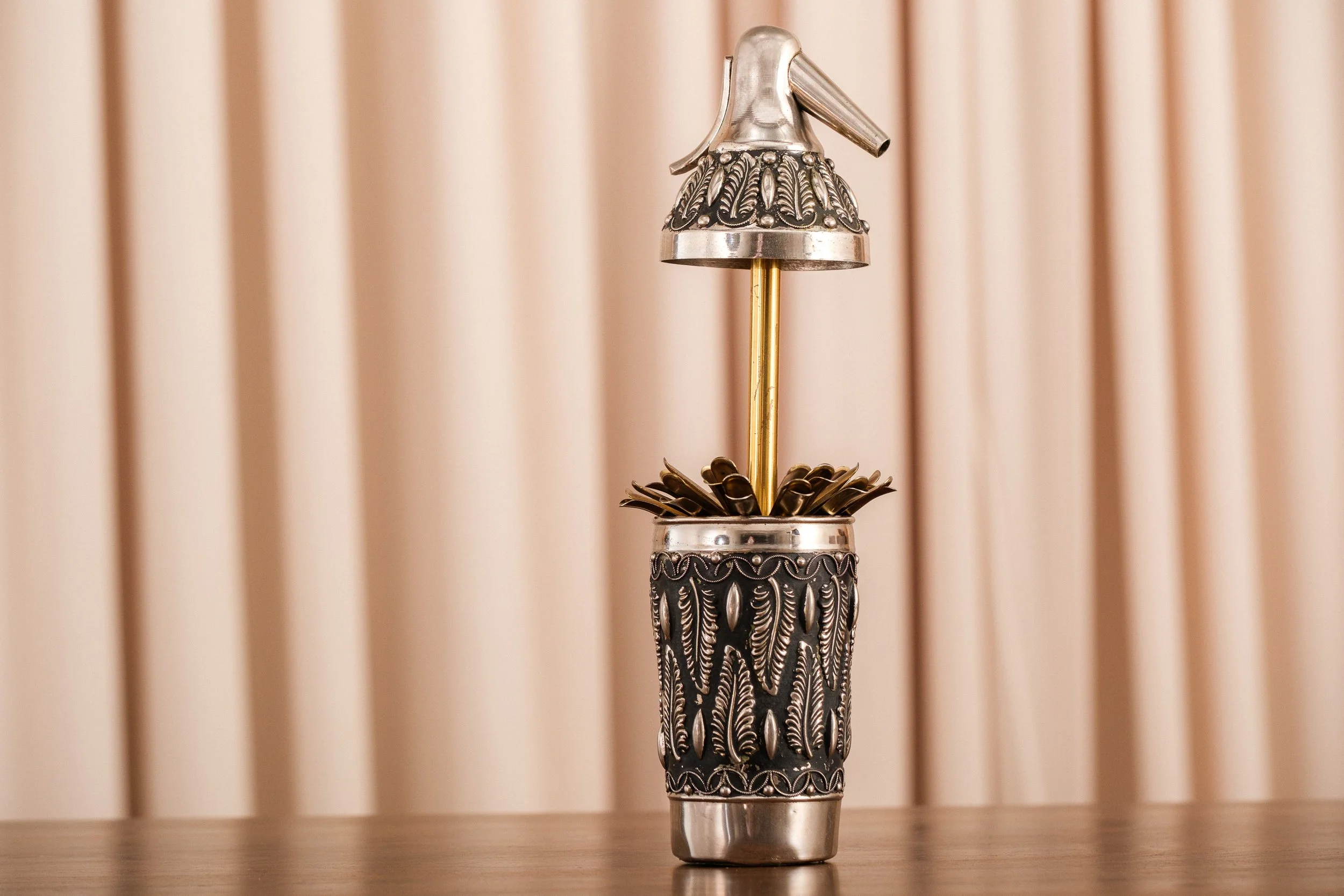
A vintage table cigarette holder in silver-toned metal with repousse floral decoration and brass detailing — a small object made with a level of craft that's hard to find today.
The cup itself is covered in hand-worked repousse decoration: layered feather and leaf motifs that wrap the entire body, with a beaded rim detail at the top. A central brass stem rises from the cup, topped with a matching repousse cap fitted with a small spout, and surrounded by a brass flower collar where the stem meets the cup. The overall effect is dense, detailed and quite striking for something that sits comfortably in the palm of a hand.
The style draws on a long tradition of ornate silversmithing, consistent with Middle Eastern, Indian, or Eastern European metalwork of the mid-20th century. There's no maker's mark we can identify. The patina is consistent with age and the piece is structurally complete and intact.
It functions equally well as a cigarette holder, a desk pencil cup, a small vase for a single stem, or simply as a decorative object on a shelf or side table.
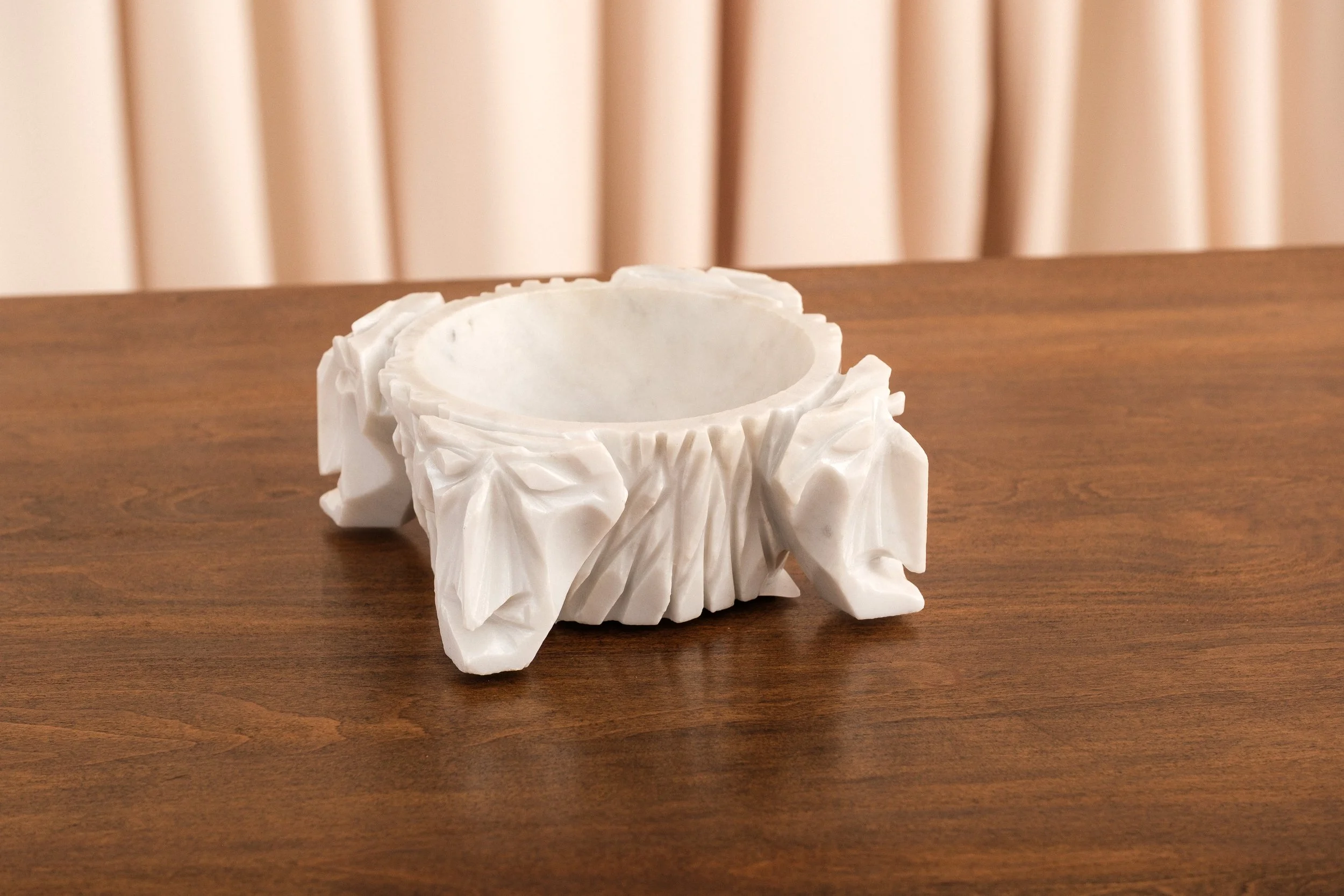
This is a small Italian valet tray, what the French call a vide poche, literally "empty pocket", carved from Carrara marble. It measures 17×17×8cm, which makes it the right size for a desk, a dresser, an entry table, or a nightstand.
What sets it apart from a plain marble tray is the carving. The four sides carry sculpted anthropomorphic faces, stylized human features rendered in the geometric, restrained manner typical of the Art Deco period. The carving is precise and the faces have a quiet presence without being overpowering. It's a decorative element that rewards close attention rather than demanding it from across the room.
The marble is white Carrara, fine-grained, with the subtle veining that distinguishes natural stone from anything synthetic. The condition is excellent: no chips, no cracks, no staining. It's heavier than you'd expect for its size, which is simply what solid marble feels like.
We're not certain of the exact date, but the style and craftsmanship are consistent with mid-20th century Italian production. There's no maker's mark that we can identify.
It works as a functional catchall or purely as a decorative object. Either way it sits well on a surface and looks considered without trying too hard.
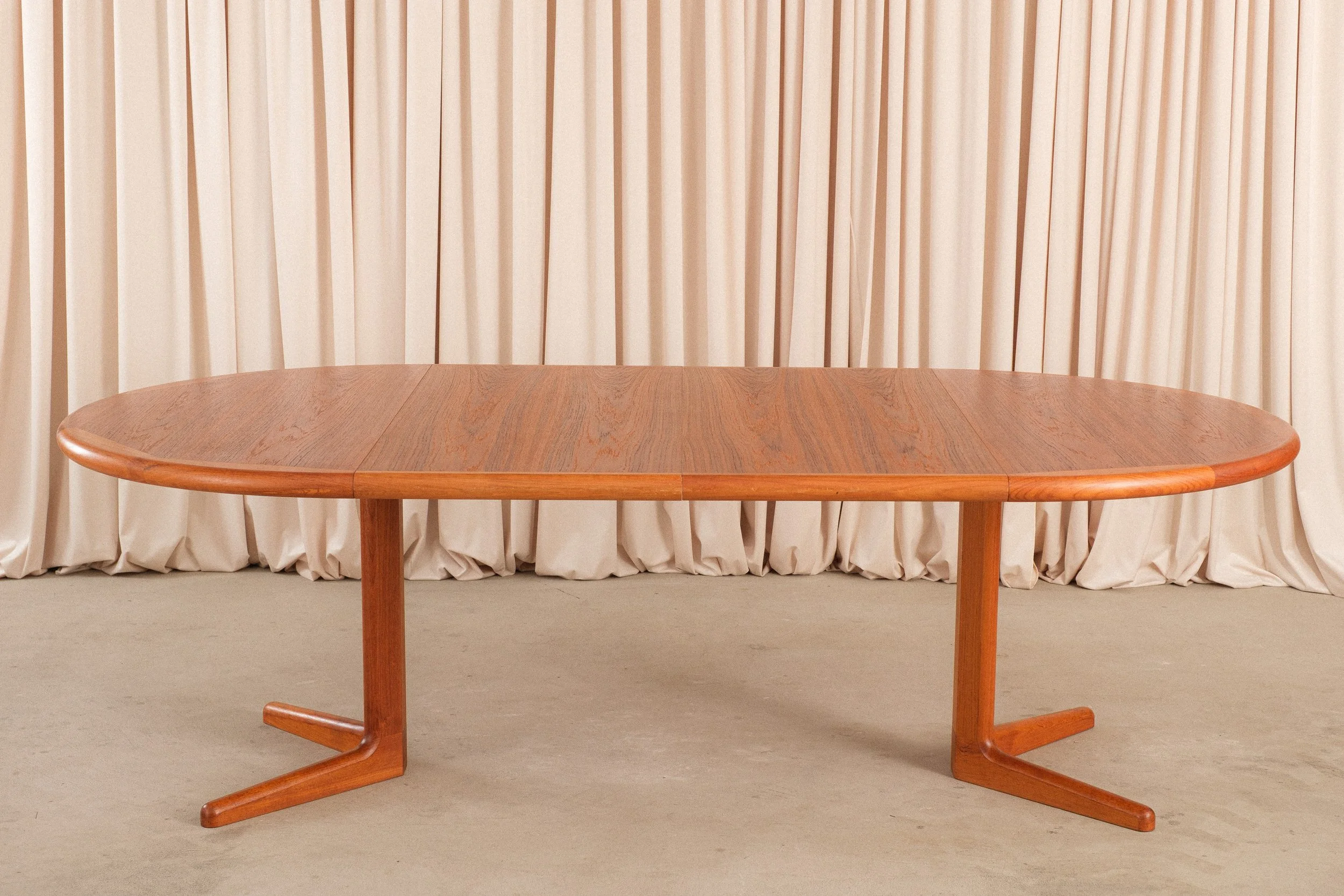
A 1960s extendable round teak dining table by Laurits M. Larsen for Møbelfabrik A/S, one of the more versatile and practical pieces of Danish mid-century furniture design.
Laurits M. Larsen was a Danish furniture maker whose work consistently demonstrated the qualities the period is known for: honest use of materials, precise joinery, and a design sensibility that prioritized how a piece actually functions in a home over purely decorative considerations. This table is a good example of that thinking.
Closed, it's a round table at 49 inches in diameter, the right size for four people and compact enough for smaller dining rooms, breakfast rooms, or kitchen spaces. Each of the two leaves adds 21 inches, extending the table to 91 inches fully open, enough to seat eight comfortably. The transition from intimate round table to generous dining surface is what makes this format so enduringly practical, and why Danish extendable tables of this type remain in constant demand.
The teak top has the warm, even grain that characterises well-selected Danish production wood of the 1960s. The surface is in excellent condition, there are a couple of minor scuffs visible in the photos, noted honestly, but no watermarks, staining, or damage. The extension mechanism works smoothly and both leaves fit flush with no visible gap or color mismatch.
It would pair naturally with the Erik Buch Model 49 floating seat chairs also available in our shop, both Danish, both teak, both 1960s.
A William Andrus sofa and matching coffee table from the Steelcase Soft Seating Group, 1972, the sofa version of one of the most awarded American furniture designs of the Space Age period.
The Soft Seating Group won the top design award for institutional furniture and innovative use of materials in 1972. Andrus's stated intention was the contrast between hard and soft, the white lacquered fiberglass shell appears to float on its transparent Lucite base, while the upholstered cushions provide the human warmth the fiberglass deliberately withholds. It's a sophisticated design idea executed with real precision.
The sofa retains its original khaki vinyl upholstery. The white fiberglass shell shows minor scuffs and chips throughout, honest vintage condition consistent with a piece that has lived in the world for over fifty years. The Lucite base is intact and the structure is sound. The matching coffee table has the same white fiberglass base with a mirrored glass top that shows age marks and clouding visible in the photos.
Price is for the sofa + coffee table set. We have also a set composed of 2 lounge chairs + another coffee table. Inquire if you want to purchase the full set as it comes with a discount.